- Applications
- Anisotropic Conductive Film for Flip Chip Applications
- Chip-on-Glass (CoG)
- Edge-Bonded Stacked Die
- Flip Chip Interconnection for Detector Arrays
- Laser Bar Bonding
- Optoelectronic Flip Chip Assembly
- Optical Module Assembly
- Putting Photons on the Chip
- RFID Assembly
- Flip Chip Bonding
- Thin Gold-to-Gold Bonding for Flip Chip
- VCSEL & Photo Diode
- Technologies
- Products
- Videos
Sales Contact
- Robert AvilaFinetech - USA/West
- Phone:
- +1 480 893 1630
- Fax:
- +1 480 893 1632
Micro AssemblyPartner ReworkPartner
Adhesive Technologies
Adhesive materials can be applied between two join partners, e.g. dice and substrates in various ways: dispensing, stencil printing, pin transfer or as film working as intermediate connection.
The Finetech Solution
Thermal Conductive Adhesives
Thermal conductive adhesives can for instance be used to mount chips on boards (COB), dice on substrates and substrates on heat sinks. Electrical interconnections can e.g. be made by wire bonding, if needed.
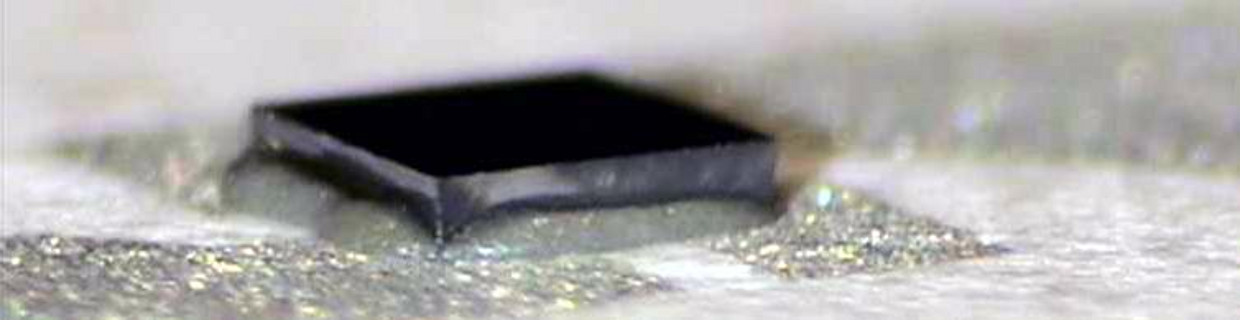
According to the dimension of the adherent surface area, the needed amount of glue can be screen printed, stamped by pins or punches, dipped with a die or dispensed by fine cannulas. The adhesives can be cured directly after assembly with a heated tool or chuck by snap curing within a few seconds or it can be cured in a batch oven later.
Isotropic Conductive Adhesives - ICA
If the electrical contact is desired to be established by the glue itself, adhesive materials filled with conductive particles can be dispensed as isotropic conductive paste (ICP) for solder replacement as well.
These adhesive materials can be handled quite similar to thermal conductive adhesives as described above. Wherever you want to realize surface mount related electrical connections without introduction of the heat needed for a soldering process, you may substitute solder by an appropriate filled adhesive and cure it in a much lower temperature process. ICA is used e.g. for backside contacted LEDs, standard SMD elements and even flip chip mounted dice with a wider pitch.
Anisotropic Conductive Adhesives - ACA
Anisotropic conductive adhesive (ACA) is filled with conductive particles but is not electrically conductive itself. As recently as this adhesive is pressed between two surfaces, the particles will touch them and each other and a conductive layer will be established in one direction. These adhesives are available as paste (ACP) or film materials (ACF).
For mechanical fixture, thermal connection and connecting multiple electrical contacts with only one adhesive material, ACA can be used and so simplifies the flip chip process. The main advantage of these materials is the low bonding temperature. The connection is cured very fast by introducing force and heat from above and additional heat from below. Drawbacks are the high bonding forces, which are needed to crash the conductive particles within the material and to create the conductivity. Accurate alignment combined with reproducible bonding forces guarantees a steady interconnection with undamaged join partners.
ACF Bonding
Attaching LCD drivers to LCD panels is one example for using ACF with chip on glass bonding (COB). In contrast to most other bonding methods, ACF bonding is reworkable. The defective component can be removed and the glass panel can be cleaned. Then new ACF preforms are placed either by an ACF module or manually by using a pair of tweezers.
In case of using anisotropic conductive film (ACF) materials several process steps are necessary:
- Pre bonding (force and temperature) of the ACF to the substrate after removing of the safety layers of the film
- Alignment of chip to substrate
- Placement of the chip onto the film
- Final bonding by force and temperature
ACP Bonding
For example in RFID applications anisotropic conductive paste is used to fix dice on antenna films. The dice have only a few pads, which are embossed by bumps or coined bumps. The conductive particles are pressed between the contacts and snap cured within a few seconds by a heated tool and may be supported by a heated chuck.
Merely a suitable dispensing module is required for integrating ACP processes in your flip chip bonding system.
Stud Bump Bonding
Another possibility for electrically connecting two contacts is to use unfilled, nonconductive adhesives (NCA) and stud bumps. This means, that conductive material (e.g. gold) is bumped on the pads of one chip. The adhesive is applied between the chip and substrate and then both join partners are pressed together. While pressing, the adhesive is displaced by the gold bumps and cares for the mechanical support and fixation.
This technique of connecting electrical contacts needs well prepared flip chip dice with gold bumps. These stud bumps can be added by a wire bonder (ball-bonder) working in stud bumping mode. The dice are then mounted by a flip chip bonder and the gold bumps are pushed against the target pads.
After placing the chip into the adhesive, it has to be held by the tool in this particular position and cured by temperature or activated by UV light.
Optical Adhesives
For optical applications it may be important to use glue with appropriate optical characteristics, e.g. index of refraction.
If adhesive material will be positioned in the principal axis of an optical system and so will affect the optical characteristics, a suitable adhesive should be used. After dispensing and attaching, these adhesives can immediately be cured by UV spot lights. Applications using optical adhesives could be mounting of glass lids, lens fixation or fiber chip coupling.
Recommended Bonding Systems
FINEPLACER® bonding systems essentially vary in
- degree of automation
- optical resolution and
- placement accuracy
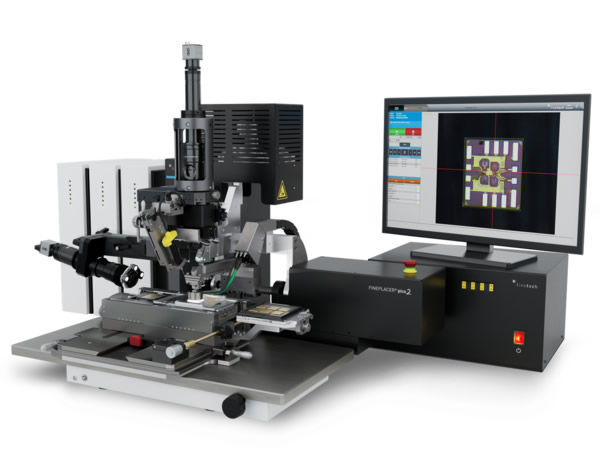
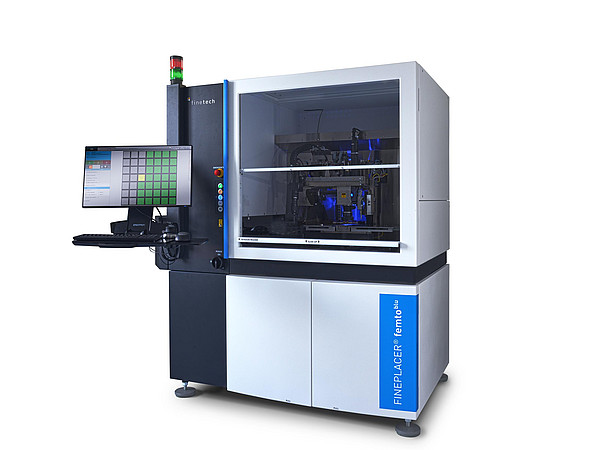
Browse our product range or get in contact with your sales contact to figure out the best equipment solution for your requirements.