Spinner
 

Laser Bar Bonding

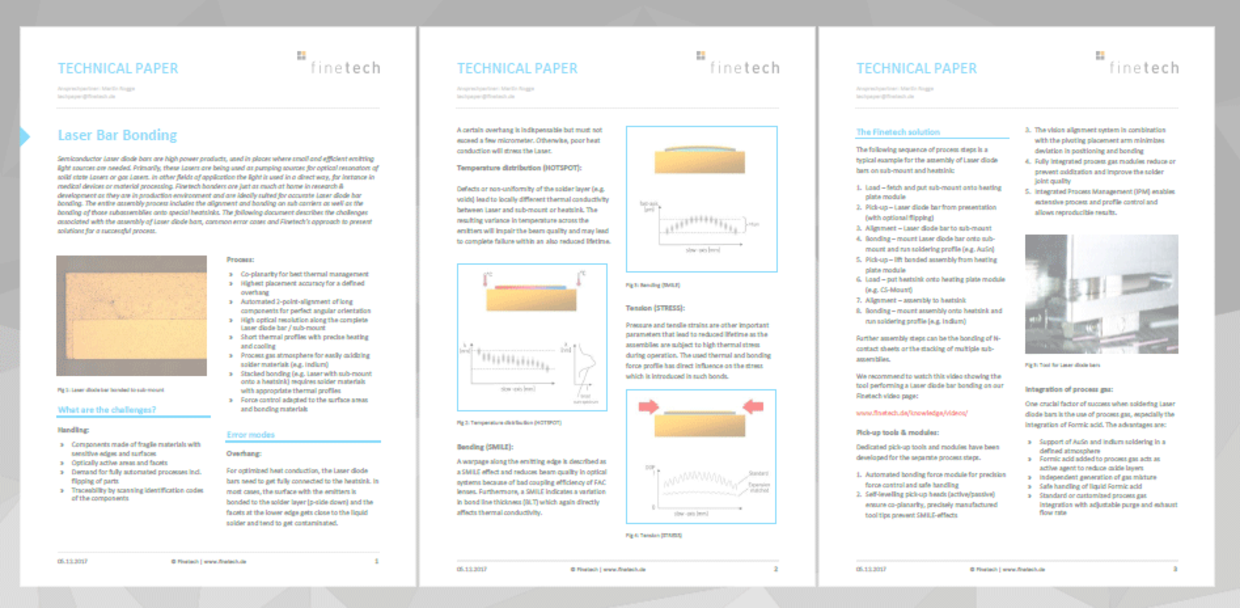
As opposed to single lasers, laser bars consist of several single edge-emitting lasers comprised in a silicon bar. Bundling the light results in significantly increased output power as needed in a wide range of applications.

Laser bars are high power products, applied wherever small and efficient light-emitting units are needed. They mainly serve as pumping sources for optical resonators of high power lasers. Another field of use can be found in medical appliances.

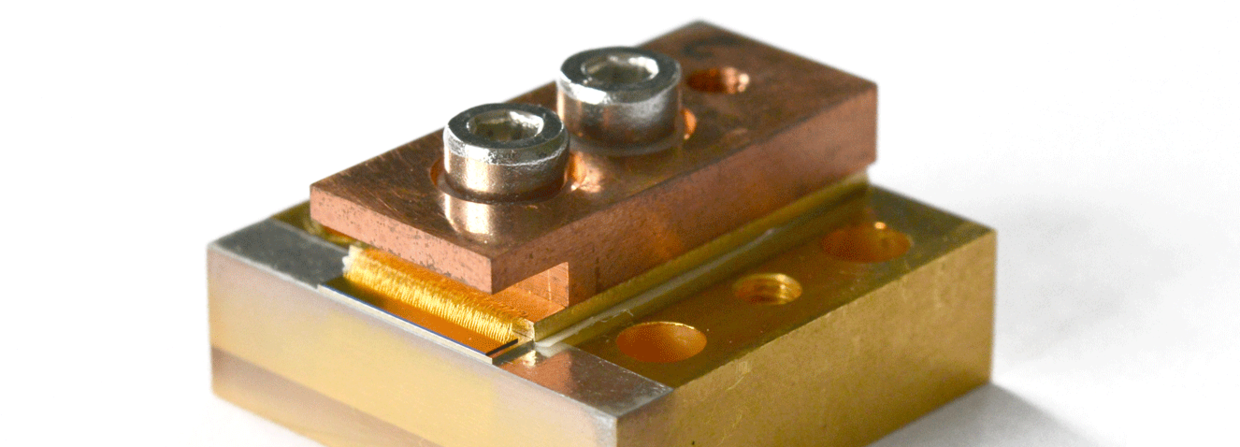
  • Laser bar bonding on heat sink
  • Cross section of bonded laser bar

What are the challenges?

Handling

  • Sensitive components with brittle materials and optically active areas
  • Delicate edges and facettes
  • Optics: highest magnification over the complete length of the laser bar/submount

Process

  • Perfect coplanarity required to ensure proper thermal management
  • Highest placement accuracy needed to ensure defined overhang
  • Solder materials are prone to oxidation, process gas integration required
  • Stacked mounting (lasers to submount) requires different solder materials with their appropriate profiles

Result:

  • Void free bonding to avoid cooling issues
  • Deformation of laser bar results in decreased emitting power (SMILE)
  • Thermal warpage shortens lifespan of the component
  • Deforming (SMILE)
    Deformation (SMILE) - The higher the SMILE value, the more affected is the beam quality of the optical system
  • Inhomogenous Cooling (Hot Spots)
    Temperature distribution (HOTSPOT) - Faulty or inhomogeneous solder layers can cause local temperature fluctuations that may result in breakdown of single emitters
  • Thermo-mechanical Warpage (Stress)
    Warpage(STRESS) - Mechanical pressure or strain warpage may result in shortened lifespan

Error Cases

  • Deformation (SMILE)
    the higher the SMILE value, the more affected is the beam quality of the optical system
  • Temperature distribution (HOTSPOT)
    Faulty or inhomogeneous solder layers can cause local temperature fluctuations that may result in breakdown of single emitters
  • Warpage(STRESS)
    mechanical pressure or strain warpage may result in shortened lifespan

The Finetech Solution

Tools & Modules

  • Laser bar tool

  • Automatic Bonding Force Module provides controlled forces and secure handling
  • Active and passive self-levelling tools guarantee even bond line, prevent SMILE effects
  • Unique fixed beam splitter, in combination with rotating placement arm, minimizes placement error
  • 2-point-alignment of long narrow components by scanning with movable optics slide
  • Optical alignment with highest magnification
  • Process gas integration to reduce/avoid oxidation and increase quality of bonding
  • IPM allows comprehensive process control and reproducible processes
  • Full-automatic processes including substrate and component handling

Step-by-step: Complete Laser Bar Assembly Process

  1. Pick-up laser bar from presentation
  2. Align laser bar to sub-mount
  3. Place and bond laser bar to sub-mount (i.e. using AuSn)
  4. Pick-up sub-assembly
  5. Align sub-assembly to heat sink (i.e. CS-mount)
  6. Place and bond sub-assembly to heat sink (i.e. using Indium)
  7. Mount N-contact sheet to top face of laser bar (z.B. InSn)

Process Gas Integration

  • Sophisticated support of AuSn and In joints under defined atmosphere
  • Employment of formic acid as process gas for shielding and reduction of oxide layers
  • Self-sufficient formic acid gas generation
  • Safe handling of fluid formic acid
  • Numerous standard and custom process gas integration methods with controlled injection and outlet
  • Automatic control of activation time and concentration for reproducible results

Integrated Process Management (IPM)

  • Integrated Process Management (IPM)
  • Principle of process gas integration
  • Operating software for bonding

The Integrated Process Management (IPM) is the center piece of a FINEPLACER® system1 - the place where it all comes together. IPM is more than just thermal management. It synchronizes the control of all process modules and their related parameters:

  • Controlled and precisely balanced interaction of top and bottom (pre-)heating and cooling
  • Control of temperature, time, force, power, energy, flow
  • Process-integrated camera and light control
  • Controlled process gas integration for reduced solder contamination, minimized surface tension effects and smooth spherical solder residues

 IPM is very complex, yet easy to access. Via the GUI of the operating software, the user has perfect control of all required adjustments. Just drag 'n drop to define temperature ramps or activate process modules. All settings are represented in only one profile, making for a very intuitive work flow.
 
The operating software provides an ever-growing library of profiles for all kinds of processes. It also offers comprehensive data logging functions essential for statistical process control.

In combination with the system-to-system process transfer capability this is as easy as process development can get.

1 FINEPLACER® core offers co-ordinated top and bottom heating but does not support IPM

Recommended Bonding Systems

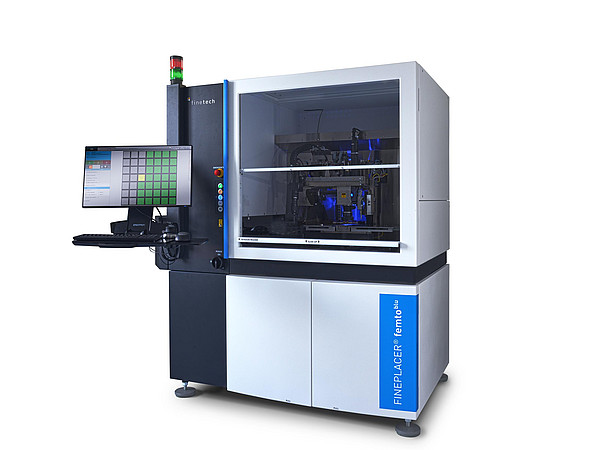
  • FINEPLACER® femto
    Automated sub-micron die bonder
  • FINEPLACER® matrix ma
    Semi-automated die bonder
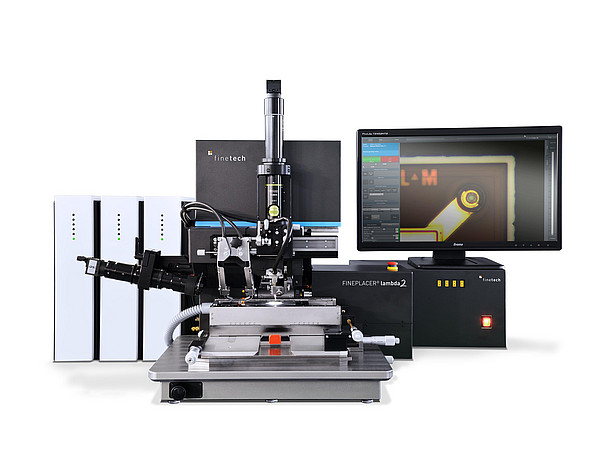
  • FINEPLACER® lambda
    Flexible sub-micron die bonder
  • FINEPLACER® pico ma
    Multi-purpose die bonder
  • FINEPLACER® pico ama
    Automated flip chip bonder

FINEPLACER® bonding systems essentially vary in 

  • degree of automation
  •  optical resolution and
  •  placement accuracy

Browse our product range or get in contact with your sales contact to figure out the best equipment solution for your requirements.